
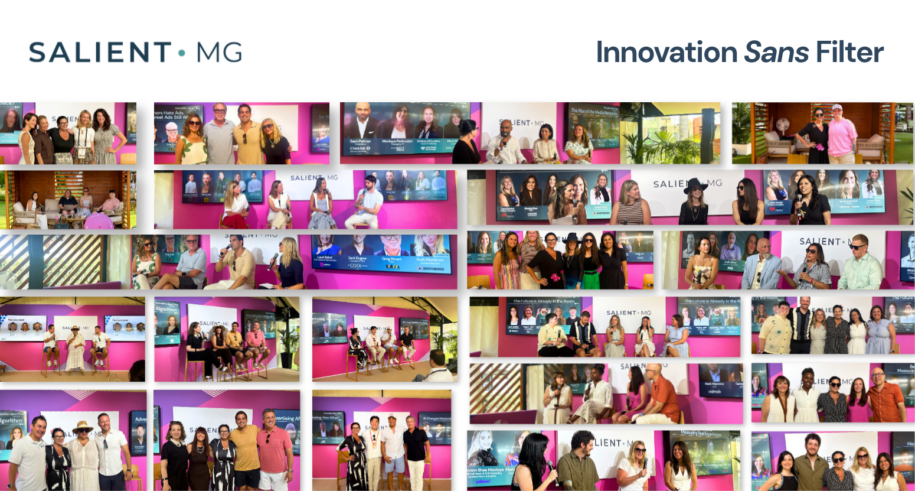
48 leaders. 4 days. 1 heat wave. 5 takeaways.
Over four days at SalientMG’s Innovation Sans Filter series at the Infillion Café in Cannes, 48 leaders from brands, agencies, media companies, and technology platforms tackled some of the biggest questions facing marketing today.
The topics ranged from AI and measurement to leadership, creativity, and community. Different perspectives, different areas of expertise, but the same themes surfaced again and again.
Here are the five ideas we’ll be thinking about long after the rosé (and heat exhaustion) have worn off.
1. The Technology Is Here. The Differentiator Is Human.
A year ago, most conversations at Cannes centered on what AI might do. This year felt different.
The technology has arrived. Marketers are already using it to write, create, analyze, and optimize. The question has shifted from “What can AI do?” to “What do we do with it?”
When everyone has access to the same tools, judgment becomes the advantage. It comes from asking better questions, recognizing what matters, understanding people, and knowing when something doesn’t quite pass the smell test.
Better tools don’t replace judgment. They make it more important.
2. Relevance Is Replacing Personalization.
Nearly every conversation touched on some version of the same idea: consumers don’t want more ads, they want better experiences.
Whether the discussion was contextual targeting, CTV, media networks, or experiential marketing, the takeaway was consistent. People respond to messages that feel useful, timely, and relevant to the moment they’re in.
The best marketing adds value instead of interrupting.
For years, marketers competed on targeting. Now, they must compete on relevance. Not just knowing who someone is, but understanding the moment they’re in and showing up in a way that actually helps.
Context has become just as important as content.
3. The Consumer Journey Is a Web, Not a Funnel.
Consumers don’t think in channels.
They don’t separate search from social, creative from media, or content from commerce. They discover products on Instagram, ask ChatGPT for recommendations, visit a website later, and make a purchase somewhere else entirely.
The journey is messy, nonlinear, and increasingly compressed.
You can no longer optimize individual channels in isolation. Now, signals must be connected across the entire experience so you can understand how each touchpoint influences the next.
Marketing is becoming less about managing channels and more about understanding connections.
4. Measurement Is Finally Catching Up to Human Behavior.
Marketing tends to measure what’s easiest to count.
Clicks. Impressions. Conversions.
Those metrics still matter. But throughout the week, more conversations focused on attention, emotion, memory, incrementality, and real-world experiences. The things that are harder to measure, but often have the biggest impact on future behavior.
Because people don’t remember a click. They remember how something made them feel. The industry seems to be moving toward a broader definition of success, one that acknowledges that not everything that matters fits neatly into a dashboard.
5. The Strongest Brands Build Participation, Not Just Reach.
Perhaps the most human theme of the week was the idea of community.
Audiences listen. Communities participate.
The brands creating lasting connections don’t just broadcast a message, they invite people into the story and give them something to contribute to, creating experiences that people want to share with others.
In an environment where attention is fragmented and content is abundant, participation may be one of the few things that can’t be easily replicated.
Reach gets you noticed, but community makes sure you’re remembered.
The More Powerful the Tools, the More Human the Work.
For a week dominated by conversations about AI, there was surprisingly little discussion about technology itself.
Instead, the conversations that stayed with us were about judgment, trust, creativity, leadership, and community. The things that don’t fit neatly into a dashboard, but often determine whether an idea, a campaign, or a brand actually resonates.
Maybe that’s the real takeaway from Cannes: the harder technology works, the more important the human stuff becomes.